Boundaries conditions
The boundaries condition for any external face of the geometry are defined using the BOUN keyword:
REFL c1 c2 …
Input parameter |
Description |
|---|---|
cx |
Reflection coefficient. Default is 0. |
The number of coefficient depends on the external volume shape and use the numbering convention of the volume faces (Available finite shapes).
The reflection probability value can take any real value.
The use the geometrical symmetries is generaly recommended whenever possible in order to:
simplify the geometrical description and reduce the number of volumes;
speed up the simulation time;
get better statistics of flux, reaction rates, etc.
Example n°1
Applying a total reflection coefficient to two adjacent faces of a box is equivalent to describing a geometry with two perpendicular planes of symmetry. Consequently, the box described below represents one-quarter of the device.

BOUN
  FACE F_1:V_v1:M_0 1.0
  FACE F_5:V_v1:M_0 1.0
ENDB
Example n°2
Applying a total reflection coefficient to two opposite faces of a box (or cylinder) is equivalent to describing an infinite number of boxes (or cylinders) replicated in the direction perpendicular to the reflective sides.

BOUN
  FACE F_1:V_v1:M_0 1.0
  FACE F_2:V_v1:M_0 1.0
ENDB
The following figure show that repeating a geometry using a total reflection coefficient (A) is not always equivalent to an infinite lattice (B).

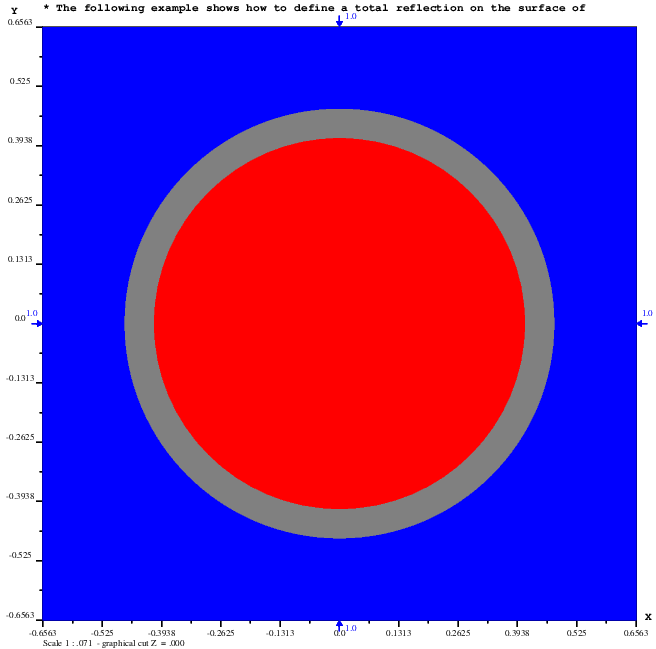
Here is a working example using boundaries reflections.
Example of using boundaries conditions
* The following example shows how to define a total reflection on the surface of
* an external volume that is a box

GEOM
  MODU 0
    TYPE 30 BOX  0.65635 0.65635  50.
    TYPE 10  CYLZ 0.4100 50.
    TYPE 20  CYLZ 0.4750 50.
    VOLU  v30    0  30   water     0.0  0.0  0.0
    VOLU  v20  v30  20   cladding  0.0  0.0  0.0
    VOLU  v10  v20  10   fuel      0.0  0.0  0.0
  ENDM

  REFL 1. 1. 1. 1. 1. 1.
ENDG